
Modern trends in construction: what will dominate in 2025
Introduction
The construction industry is undergoing a rapid transformation driven by technology, the need for greater efficiency, and a growing environmental awareness. What once seemed futuristic is now a reality that directly influences how projects are designed, managed, and executed. In 2025, these innovations will become even more evident, marking a before and after in the way we build.
Modular Construction: Speed, Precision, and Sustainability
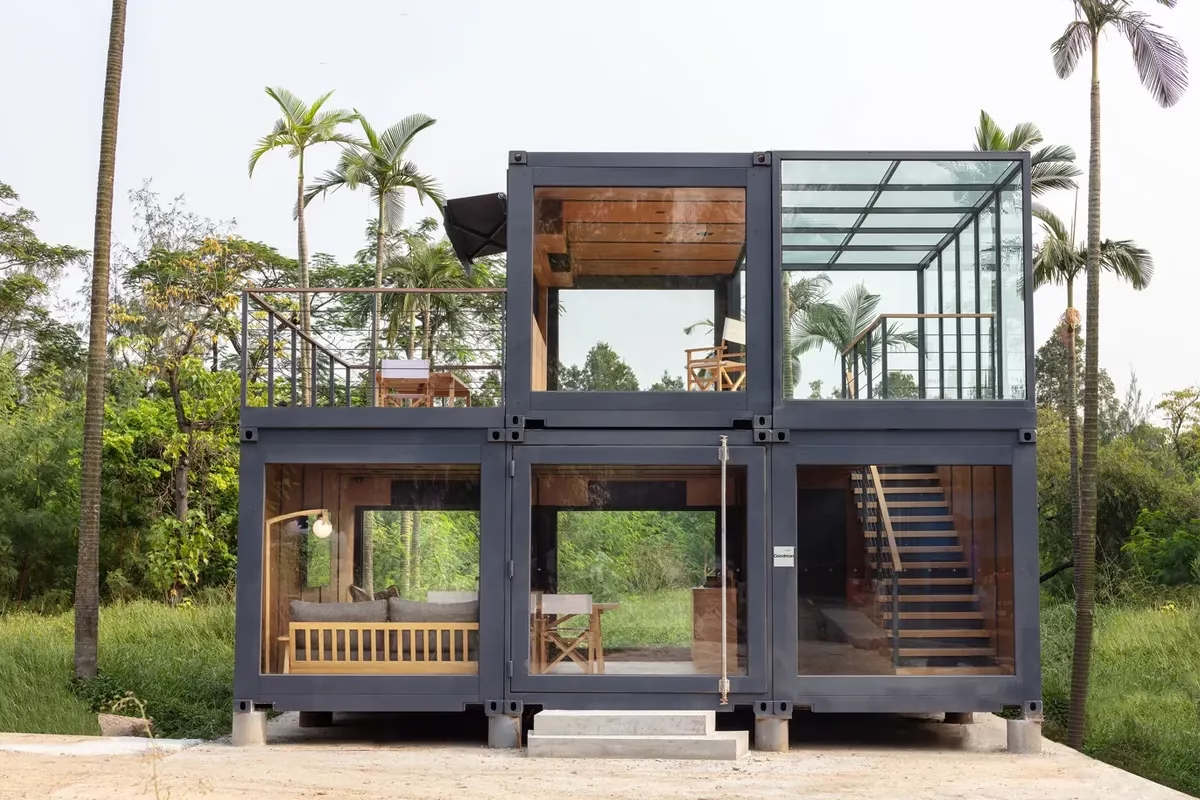
Modular construction continues to establish itself as one of the fastest-growing building methodologies. Its main strength lies in the ability to manufacture complete sections of a structure in controlled environments and then assemble them on-site.
This offers multiple benefits, such as significantly shorter construction times, less waste, lower environmental impact, and a higher level of precision compared to traditional methods. In addition, this technique makes it possible to produce homes, offices, and buildings with consistent quality and more predictable costs.
Sustainable Buildings and Energy Efficiency
Sustainability is no longer just a trend—it has become a standard demanded by consumers, regulations, and the global market. Modern constructions incorporate materials such as eco-friendly concrete, treated wood, recycled steel, and non-toxic paints.
Similarly, smart energy systems—such as integrated solar panels, motion sensors, and automated climate control—have become an essential part of new projects. Buildings now aim to reduce emissions, save energy, and enhance user comfort.
BIM as the Center of Digital Coordination
Building Information Modeling (BIM) is revolutionizing the industry. It is a three-dimensional digital model that allows you to visualize, plan, and coordinate the entire project with millimetric precision.
With BIM, architects, engineers, and builders work in the same digital environment, avoiding errors, reducing cost overruns, and achieving an efficiency that was previously impossible. By 2025, virtually all medium- and large-scale projects will use BIM as their primary tool.
IoT Technology and Automation
Smart sensors are now part of everyday construction. They allow real-time monitoring of vibrations, humidity, temperature, and movement, increasing on-site safety and helping detect failures before they become major issues.
They are also used in completed buildings to optimize energy consumption, regulate lighting, and maintain occupant comfort without manual intervention.
Conclusion
The construction of the future is sustainable, modular, and fully digital. Adapting to these new ways of working allows for the development of more efficient, cost-effective, and functional projects that meet the current needs of the market.